

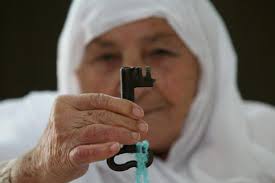
Palestinian right of return
Uploaded on Jul 30, 2008
More at http://therealnews.com/c.php?c=080701YT
Aijaz Ahmad: What would a rational US foreign policy look like? Pt 9
Kufr Birim: The right of return to Palestine
Last updated: 12 Aug 2014 17:21
Palestinian refugees in Israel are part of the Palestinian national struggle.

The latest attempt to intimidate the Palestinian community inside present-day Israel took place on August 11, when officers from the Israeli Land Administration (ILA) showed up in Kufr Birim, a destroyed Palestinian village where I and more than a dozen other activists have been camping in shifts since August 2013.
The ILA threatened to cut the water and electricity to the kitchen we built, as well as confiscate our camping supplies, such as blankets, mattresses and tents. They also demanded that we evacuate the area and warned that they will return soon with police forces.
| The Nakba |
Most of us are descendants of the Palestinians ethnically cleansed from Kufr Birim during the 1948 Nakba, when Palestine was destroyed in order to make way for Israel as an exclusively Jewish state. Internally displaced within the borders of what became Israel, today we are part of the 1.7 million Palestinians who hold Israeli citizenship and suffer from more than 50 discriminatory laws that limit our access to state resources and stifle our political expression.
Persisting intimidation
This was not Israel’s first attack on us. In 1953, just five years after our grandparents were expelled from their village, Israel’s Supreme Court demanded that the military provide an explanation for preventing the return of Kufr Birim’s refugees. When the court decided we could return, Israeli warplanes defied the ruling and bombs homes, schools and businesses. Only a historical church was left intact.
Like most of the more than 600 Palestinian villages and towns destroyed during the Nakba, much of Kufr Birim’s land was divided between new Jewish agricultural communities (Kibbutzim) and the rest was turned into a national park, where international and domestic tourists, as well as Israeli soldiers, go on retreat and are taught a brand of history that ignores the village’s Palestinian history and heritage.
For decades Palestinian citizens of Israel have been tokenised by rightwing and leftwing politicians alike, dubbed “Arab Israelis” and stripped of our national identity. Meanwhile, the international community and mainstream media have stood by with folded arms, hesitant to include us in the discourse on Israel and Palestine because we are considered an “internal issue”.
For decades we have tried to work for reconciliation within Israel’s political system. Yet as Israel’s mainstream establishment plunges further into racist rightwing frenzy, it becomes clearer each day that it is impossible to work within a system designed to exclude us.
Like Palestinians everywhere, we are part of the national struggle. And like the more than five million UN-registered Palestinian refugees scattered across the Middle East, internally displaced Palestinians have a right to return to and rebuild their ancestral lands.
This is why we have returned to Kufr Birim by following the lead of others who had already returned to Iqrit, another destroyed Palestinian village in the Galilee region of Israel where young activists have camped for more than two years despite frequent police harassment and harsh weather conditions.
 |
| The Palestinian village of Kufr Birim was destroyed in the 1948 Nakba [Tony Ayoub] |
Al-Awda Hariket Abna’ Kufr Birim Al-Taqodumeyon (“The Return of the Progressive Sons of Kufr Birim”), an organisation founded by second generation refugees from the village, including my father, was established in 1982 in response to the efforts to strip us of our Palestinian heritage.
Since its beginning, Al-Awda has worked tirelessly as a part of the Palestinian national struggle, including the campaign for the right of return for all Palestinian refugees. After the group’s first action, an event for Palestinian Land Day, campaigners began in 1984 an annual youth camp stressing our desire and need to return to Kufr Birim.
As the first generation of Kufr Birim’s refugees expires, our annual camp aims to teach youth about the village’s history while stressing the role of all internally displaced Palestinians as part of a broader national entity. Along with Al-Awda, of which I am also a part, dozens of Kufr Birim’s descendants are playing a crucial role in supporting our return.
I’ve been going to the annual camp each year for my entire life. Since my childhood, relatives and family friends who witnessed 1948 have told me about life before the Zionist militias expelled them, explaining that the community was based on agricultural and not part of armed resistance during the Nakba.
They told me and my cousins of how the Israeli army stuffed them in vehicles and tried to drop them off at the Lebanese border, urging them to forget where they came from. Growing up, my father told my siblings and I how his uncle was shot and killed while trying to return to his home.
At present an Israeli court is investigating whether we even have the right to stay on our land in tents, although Israeli land authorities have banned us from building anything whatsoever. But we know that Israel’s legal system – designed to sustain a Jewish-only state at our expense – is incapable of delivering justice to Palestinians, whether they be in Israel or the occupied Palestinian territories.
Israeli authorities, accompanied by police, come to demolish anything we build. By threatening to cut our water and electricity, they show that they are willing to do anything to make the conditions in Kufr Birim too difficult for us to remain.
But nothing can keep us from exercising our right of return. As Palestinian refugees inside Israel, we have already been robbed of the most important thing – our land. With nothing to lose, returning to my grandfather’s land is how I play an integral part in the Palestinian struggle against Israel’s regime of occupation, colonisation and dispossession.
Waad Ghantous is a Haifa-based Palestinian activist and a member of the Al-Awda organisation.
Follow her on Twitter: @wa3dghantous
The views expressed in this article are the author’s own and do not necessarily reflect Al Jazeera’s editorial policy.
Right of Return – Doc Jazz
Uploaded on Dec 17, 2011
Music video by Doc Jazz, for the song ‘Right of Return’, released on December 17th, 2011.
LYRICS – http://www.soundclick.com/bands/_music_lyrics.cfm?
The Question of the Palestinians’ Right of Return – Prof. Yaffa Zilbershats
Published on Mar 7, 2012
Prof. Yaffa Zilbershats, Deputy President of Bar-Ilan University in The 7th
Ambassadors’ Forum held on 31 January 2012.
The speaker claims that the Palestinians don’t have the legal right of return. Furthermore, by consistently employing the term “Right of Return”, the peace process cannot progress.
The Palestinian right of return-Remember Palestine-06-30-2012
http://youtu.be/8Zbl_rbaYSs
Published on Jul 1, 2012
The Palestinian Return Centre (PRC) will commemorate international refugee day by hosting a number of events across Europe. The events will commence in the UK on 18 June and end in Geneva 22 June. International Refugee Day is an annual event launched by the United Nations to highlight the plight of millions of refugees worldwide who are forced to flee their homes. Palestinian refugees comprise of the largest and longest standing case of refugees and displaced persons in modern history.
2012 marked the 64th anniversary of the Nakba, the beginning of their ongoing cycle of exile and dispossession. 64 years on Palestinians all over the world are facing many desperate challenges. In Israel, Gaza, Jerusalem, Iraq, Syria, Lebanon, Jerusalem, Libya, Brazil and across many other parts of the world, Palestinians are subjected to gross violations of their basic human rights.
Watch this video on our Website: http://www.presstv.com/Program/248822…
Follow our Facebook on: https://www.facebook.com/presstvchannel
Follow our Twitter on: http://twitter.com/presstv
Redefining the Right of Return: Will the US Congress Succeed?
Published on Jul 16, 2012
In this episode of Palestine Studies TV, we discuss a recent attempt by the US Senate to change the US government’s policy on how Palestinian refugees are defined. We explore how this legislation could impact negotiations on the right of return, as well as the potential consequences for UNRWA and the 5 million refugees it serves in the occupied Palestinian territories and neighboring countries.
This episode’s guest:
Josh Ruebner, National Advocacy Director at the US Campaign to End the Israeli Occupation, provides valuable insights into the new legislation and how it will affect Palestinian refugees.
Palestine Studies TV is a project of the Institute for Palestine Studies.
Right of Return Conference: “Refugees Between NGOs, Legal Status and Return” Panel
Published on Jun 28, 2013
Right of Return Conference
Panel: Disappearing and Reappearing: Refugees Between NGOs, Legal Status and Return
Moderator: Susan Akram
Anne Irfan: Handing Back the Keys: UNRWA and the Right of Return
Jinan Bastaki: Disappearing Refugees and the Legal Gaps: The Implications of Third Country Citizenship for Palestinian Refugees and the Right of Return
Right of Return Conference Day 1: Opening Remarks
Published on May 9, 2013
The Right of Return Conference was held at Boston University on April 6 and 7, 2013. The conference featured keynote presentations by Dr. Salman Abu Sitta, Dr. Joseph Massad, Noura Erakat (Badil) and Liat Rosenberg (Zochrot).
Opening remarks were made by conference organizer Zena Ozeir
Right of Return Conference Day 1: Salman Abu Sitta Keynote
Published on May 14, 2013
Salman H. Abu Sitta is a Palestinian researcher who writes about Palestinian refugees and the Palestinian Right of Return. Abu Sitta is a former member of the Palestinian National Council, the founder and President of the Palestine Land Society and is the general coordinator of the Right of Return Congress. He has written over 300 articles and papers on Palestinian refugees and the Right of Return.
Among his published works are:
The Return Journey (2007) in Arabic, English and Hebrew, Atlas of Palestine, 1948 (January 2004), Atlas of Palestine 1917-1966, two editions, Arabic and English, and Nakba 1948: The register of depopulated localities in Palestine (Occasional Return Centre studies) (1998 reprinted 2000)
The Right of Return Conference was held at Boston University on April 6 and 7, 2013. The conference featured keynote presentations by Dr. Salman Abu Sitta, Dr. Joseph Massad, Noura Erakat (Badil) and Liat Rosenberg (Zochrot).
Right of Return Conference Day 1: Identities on Display: Collective Identity and Daily Practice
Published on Jun 5, 2013
Moderator: Amahl Bishara
Panelists:
Joseph Greene: The Palestine Archaeological Museum: Disentangling Cultural Heritage “After the Return”
Riccardo Bocco: Collective Memory and Dreams of Return: A Journey through Documentary Films Portraying Palestinian Refugees.
Right of Return Conference Day 1: Closing Remarks
http://youtu.be/ZGgqiKDWIZ0
Published on May 9, 2013
The Right of Return Conference was held at Boston University on April 6 and 7, 2013. The conference featured keynote presentations by Dr. Salman Abu Sitta, Dr. Joseph Massad, Noura Erakat (Badil) and Liat Rosenberg (Zochrot).
Closing remarks were made by conference organizer Jamil Sbitan
Right of Return Conference Day 2: Joseph Massad Keynote Address
Published on Jun 3, 2013
Joseph Massad teaches Modern Arab Politics and Intellectual History at Columbia University. He is the author of Colonial Effects: The Making of National Identity in Jordan (Columbia University Press, 2001), The Persistence of the Palestinian Question: Essays on Zionism and Palestinian Nationalism (Routledge, 2006), Desiring Arabs (University of Chicago Press, 2007). His book Desiring Arabs received the Lionel Trilling Book Award in 2008. Professor Massad has written extensively on the Palestinian Question in academic journals and books. He also writes columns on Palestinian and Arab affairs to Al-Jazeera English’s website, Al-Ahram Weekly, and the Lebanese daily Al-Akhbar. His forthcoming book is titled Islam in Liberalism.
The Right of Return Conference was held at Boston University on April 6 and 7, 2013. The conference featured keynote presentations by Dr. Salman Abu Sitta, Dr. Joseph Massad, Noura Erakat (Badil) and Liat Rosenberg (Zochrot).
Right of Return Conference Day 2: Noura Erakat & Liat Rosenberg Keynote
Published on May 14, 2013
Noura Erakat is a human rights attorney and activist. She is currently a Abraham L. Freedman Teaching Fellow at Temple University, Beasley School of Law and the U.S.-based Legal Advocacy Consultant for the Badil Resource Center for Palestinian Refugee and Residency Rights.
Rosenberg is currently the director of Zochrot, an NGO that promotes the acknowledgment, accountability and responsibility of the Israeli public to the ongoing crimes of the Nakba and the return of the Palestinian refugees.
The Right of Return Conference was held at Boston University on April 6 and 7, 2013. The conference featured keynote presentations by Dr. Salman Abu Sitta, Dr. Joseph Massad, Noura Erakat (Badil) and Liat Rosenberg (Zochrot).
Right of Return Conference Day 2: Imagining Spaces of Return and Mapping Palestinian Liberation
Published on Jun 28, 2013
“Imagining Spaces of Return & Mapping Palestinian Liberation”
Moderator: Salim Tamari
Linda Quiquivix: Liberation or Independence: Palestine as Land or Palestine as Territory?
Einat Manoff: Counter-mapping and the Geographical Imagination: Mapping Spatial Scenarios of Return
Thomas Abowd: The Return of Homes and the Restitution of History in Jerusalem
Right of Return Conference Day 2: Palestinian Politics and Models for Return
Published on Jun 27, 2013
Moderator: Leila Farsakh
Sarah I.: Who Is A Palestinian? Political Representation of the Shatat in the Homeland